
Attachment Styles 101
Struggling with relationships? Read on to learn a possible explanation for why.

Mental health has become much more widely discussed in the past about decade now. One of the core concepts that affects everyone’s mental health is attachment styles. Attachment styles describe how we relate to the world based on our relationships with our primary caregivers. Attachment styles are being talked about through a wide variety of sources now such as: social media, therapy, and psychiatry.
Personally, I have been getting into attachment styles the past 2 years now to learn more about my attachment styles and how it impacts my emotional patterns and how I show up in interpersonal relationships. I have been wanting to discuss attachment theory for a while now. I feel like this is a very relevant topic that applies to everyone regardless of neurotype. I am excited to do a bit of breakdown of attachment styles in this article!
Disclaimer: This article is NOT a diagnosis tool for your attachment style. To identify your attachment style, I recommend you go to a therapist or psychiatrist who specializes in attachment styles. I have also found a test that is pretty accurate in describing where you are at in the attachment spectrum. I’ll drop the link down below. What I like about this particular test is that it emphasizes the idea that attachment is on a spectrum. Which is true no one is going to fit cleanly into one single attachment style. Instead, everyone will have one dominant attachment style that is used.
Attachment Style Test: https://traumasolutions.com/attachment-styles-quiz/
Origins of Attachment Theory
So how did attachment theory originate? Attachment Theory was originally created by psychiatrist John Bowlby and psychologist Mary Ainsworth in the 1960s. They did a strange situation which ended up being an objective, observable way for kids to elicit different patterns of attachment behaviors. Bowlby then utilized the internal working models concept from psychologist Kenneth Clark. Bowlby ended up combining his observation and the internal working methods to discover and define the different attachment styles.
Types of Attachment Styles
There are four attachment styles: one secure and three insecure attachment strategies.
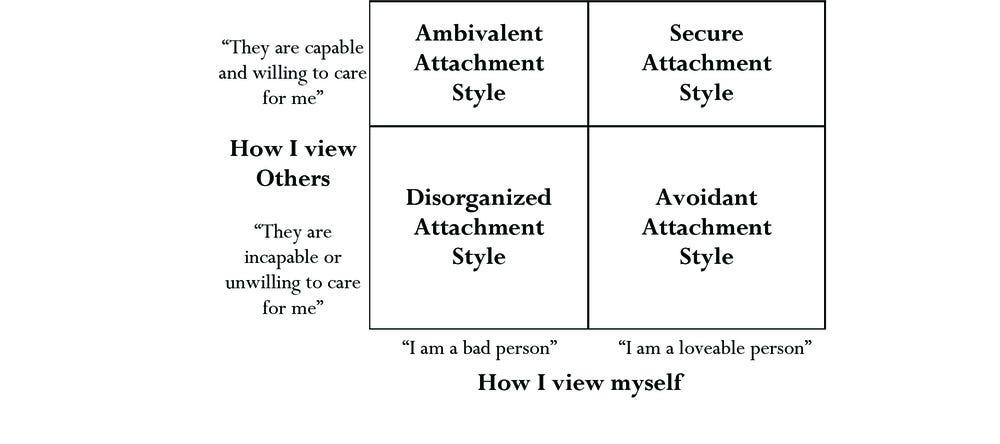
Secure Attachment: these people feel comfortable both in and out of a relationship. Feel naturally centered and grounded. Solid balance between intimacy and independence. Have both a positive sense of self and a positive attitude of others.
Anxious-Preoccupied Attachment: these people feel comfortable in relationships but not comfortable alone. These types tend to need a lot of reassurance from others that others are okay and not upset with them. Can be prone to being clingy in relationships. Tends to hyperfixate on their relationships. Can be vulnerable to emotionally depending on others for their self-worth. Have a negative sense of self and a positive view of others.
Dismissive Avoidant Attachment: these people feel comfortable on their own or not in close relationships. Can have friends or relationships but struggle to build emotional intimacy.These types can struggle with asking for help and relying on other people. Tend to believe they can 100% take care of themselves. Can lean towards hyper independence and devalue the importance of connection and community. Tend to feel “controlled” and restricted in relationships. Have a positive sense of self and a negative view of others.
Fearful (Disorganized) Avoidant Attachment: so this attachment is the most complex of them all. Basically, it combines the negative traits of both the anxious and avoidant attachment style. Tend to alternate between being hyperfixate on relationships and distancing or dismissing the importance of interpersonal connection. Unlike, in a secure attachment style they can also struggle with low-self-esteem and/or toxic shame. (All insecure attachment styles can struggle with this) Usually, this attachment style comes out of unpredictable home environments. Have both a negative view of self and a negative view of others.
Can you become more secure if you have a dominant insecure attachment style?
Short Answer: Absolutely Yes!
We all have the capacity to heal from insecure attachment styles that are no longer working for us in our lives. It won’t happen overnight because these insecure attachment styles often worked very well in our initial caregiving environments. It can take years and even decades to heal from an insecure attachment style. But you can move towards what they call in the attachment community an “earned” secure attachment style.
Here’s an inspirational quote from Anna Aslanian, Licensed Marriage Family Therapist
“Look at yourself through the lens of compassion and understanding. Only then growth is possible”
What are some methods you can use to heal from an insecure attachment style?
Psychotherapy: A therapist can teach you coping strategies for dealing with your emotions or relationship issues. They can teach you strategies for better managing your emotions and expressing your feelings in your interpersonal relationships. Common benefits of psychotherapy include: higher self-esteem and stronger interpersonal relationships.
Relationships with Securely Attached People: Relating to people who are more securely attached can slowly start to give you a healthier model of secure relationship. If a secure person is willing to do it, they can teach you how to relate to people in a healthy way with a solid balance of compassion and reason. This can also help you to train your nervous system overtime to start seeing the world through that “I am okay, you are okay” secure worldview. Then potentially being able to move through the world with more confidence and trust.
Compassion and Empathy: It’s also beneficial to practice compassion and empathy towards both yourself and other people. Self-compassion will allow you to be accepting towards yourself as you navigate the healing process. This will overtime allow you to begin to accept your flaws and embrace who you are. Having compassion towards others will allow you to also see that others are human and also have their own vulnerabilities. It also allows you to give others grace and empathy. This can also help improve your interpersonal relationships.